
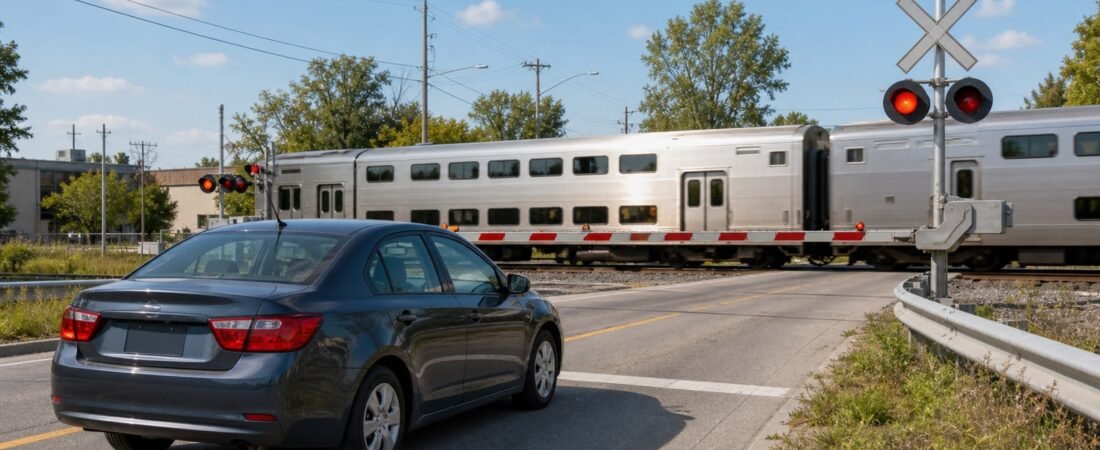
A railway crossing can look quiet right up until its lights activate. For a learner driver in Scarborough, the safest approach is never based on guessing whether a train is coming. Read the warning signs early, slow down smoothly, keep space ahead and cross only when your entire vehicle can clear the tracks.
Recognize a Railway Crossing Before You Reach It
Ontario public-road railway crossings are marked with a red-and-white X-shaped railway crossing sign. You may also see a yellow advance-warning sign, a large X painted on the pavement, flashing red lights, bells, gates or a posted stop sign. The Official MTO Driver’s Handbook sign guide tells drivers to slow down, look both ways and be prepared to stop when they see the railway sign.
Do not wait for flashing lights before you begin observing. Some public crossings have fewer active warning devices, and private-road crossings may be marked differently. Your first task is to notice the tracks, understand the controls at that crossing and reduce speed early enough to make a calm decision.
A Simple Approach Routine: Mirror, Slow, Scan, Space
Use this four-part routine as soon as you recognize the crossing:
- Mirror: Check behind you before slowing. A driver following too closely may not have noticed the crossing.
- Slow: Ease off the accelerator and brake progressively. Avoid a last-second stop that surprises traffic behind you.
- Scan: Look left and right along the tracks, listen, and check the lights, gate and any instructions from a flag person.
- Space: Confirm there is enough open road on the far side for your entire vehicle before you enter the crossing.
A safe following gap makes this much easier. SparkOn’s guide to following distance in Ontario explains how to preserve the time and sightline you need when traffic ahead slows unexpectedly.
When You Must Stop for a Train
Ontario’s official railway-crossing safety guidance says that when a train is coming, drivers should stop at least five metres from the nearest rail or gate. Never race a train or try to judge whether you can slip through before it arrives.
You must also obey the controls at the crossing:
- Stop for flashing railway signals.
- Stop at a posted stop sign unless a flag person directs otherwise.
- Do not drive around, under or through a gate while it is down, lowering or rising.
- Follow the directions of railway or traffic-control personnel.
Leave a clear buffer rather than creeping toward the gate. The stop position should keep your vehicle, mirrors and any load safely away from the barrier and tracks.
Wait for the Whole Warning Sequence to Finish
After the train passes, do not move simply because the last rail car has cleared your lane. The MTO says to wait until the signal lights stop flashing and the gate or barrier rises before crossing. Then look both ways again for another train.
A second train may be hidden by the first or may approach on another track. Treat the lights and gate as the controlling information. A driver behind you may become impatient, but a horn does not change the signal or make the crossing safe.
At night or in glare, it can be harder to judge distance and movement along the tracks. Keep the windshield clean, reduce speed earlier and use the visibility habits in SparkOn’s Scarborough night-driving guide.
Never Enter Unless You Can Clear the Tracks
Traffic may be moving when you approach, yet stop immediately after the tracks. Before proceeding, identify a space on the far side large enough for your entire vehicle. If that space is not available, wait before the crossing—even if the vehicle ahead has moved and no train is visible.
Do not stop with any part of the vehicle over a rail. This matters in slow rush-hour queues, near traffic signals and when congestion changes quickly. Watch the far side, not only the bumper directly ahead.
Once you start across, travel smoothly in the same lane. Avoid changing gears on the tracks because a stalled vehicle creates an emergency. Maintain steady control over uneven rails, and do not stop to reconsider in the middle.
Be Ready for Buses to Stop
School buses must stop at railway crossings, whether or not gates or signal lights are present. Most other buses and public vehicles must stop at crossings without automatic protection. Their upper school-bus red lights are not used for the railway stop, so a learner driver may not receive the warning they expect.
When following a bus near tracks, increase your space and expect it to stop. Do not dart around it toward the crossing. SparkOn’s guide to school buses in Scarborough explains how railway stops differ from passenger-loading stops with flashing red lights.
What to Do If Your Vehicle Gets Stuck on the Tracks
If a vehicle stalls or becomes trapped on a crossing, treat it as an immediate emergency:
- Get every person out of the vehicle immediately.
- Move quickly away from the tracks to a safe location. Ontario advises getting at least 30 metres away because debris may be thrown if a train strikes the vehicle.
- Contact police and follow emergency instructions.
Do not stay inside to troubleshoot, collect belongings or repeatedly restart the engine. People come first. The vehicle can be dealt with only after everyone is away from the danger area and authorities have been contacted.
Common Railway-Crossing Mistakes to Avoid
- Accelerating to beat a gate that has started moving.
- Stopping too close to the nearest rail or barrier.
- Following another vehicle onto the tracks without checking the far-side space.
- Moving as soon as the train passes while the lights still flash.
- Assuming there cannot be a second train.
- Passing a bus that has stopped before the tracks.
- Changing gears, changing lanes or stopping while crossing.
- Remaining in a stalled vehicle on the tracks.
Scarborough Learner Practice Checklist
You do not need a supposed road-test route to build a reliable railway-crossing habit. During supervised practice or a structured road-test preparation lesson, ask your accompanying driver to watch whether you:
- recognize the advance warning and X-shaped crossing signs early;
- check the mirror before slowing;
- look and listen in both directions along the tracks;
- stop with a safe buffer when signals, gates, signs or a train require it;
- wait for all warning devices to finish their sequence;
- check for another train before proceeding;
- identify enough space beyond the tracks before entering; and
- cross smoothly without shifting, stopping or drifting lanes.
Begin in daylight and lighter traffic so the observation sequence becomes familiar. Add busier conditions only when you can approach, decide and proceed without rushing.
Practise Railway Crossings With a Scarborough Instructor
SparkOn’s one-on-one driving lessons in Scarborough help G1, G2 and G drivers practise early observation, smooth stopping, traffic-space judgment and calm decisions around railway crossings and other changing road conditions.
Book a Scarborough driving lesson and tell us which situations you want to handle more confidently.