
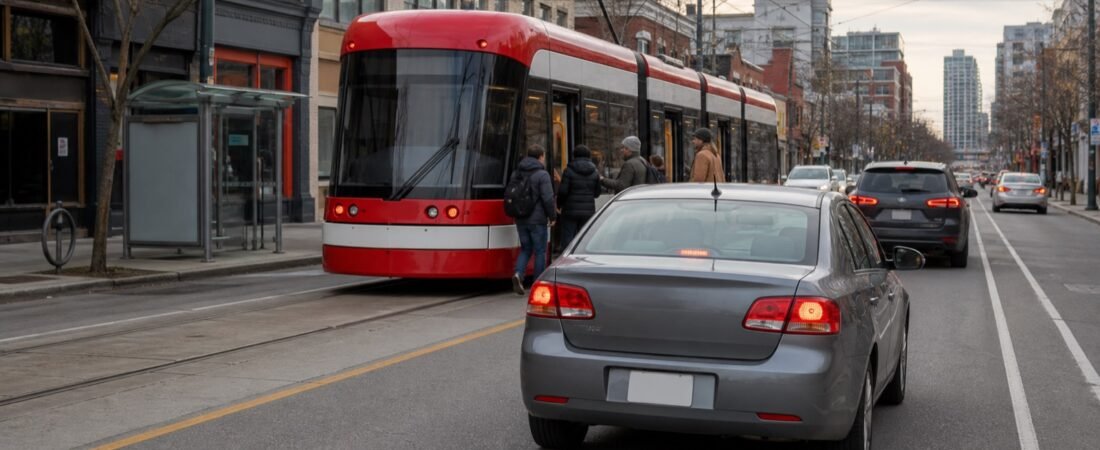
If you learn in Scarborough, you may do most of your practice without streetcar tracks. Then one trip toward Toronto’s older mixed-traffic corridors puts rails, overhead wires, passengers and a large vehicle in the same space. The first reaction is often to stare at the streetcar or move around it too quickly.
My advice is simple: slow down early, identify where people will board or step off, and make one clear decision. Streetcars are predictable when you give yourself time to read the stop. They become stressful when you arrive beside open doors with no plan.
The Ontario rules you need to know
The Official MTO Driver’s Handbook says you must pass a streetcar on the right unless you are driving on a one-way road. At a stop where passengers are getting on or off, stay at least two metres behind the rear doors. You wait until the doors close and people have reached the sidewalk before you continue. The two-metre rule is different at a stop with a separate passenger area or safety island, but you still pass at a reasonable speed and expect pedestrians to move unexpectedly.
That is the official rule. My instructor recommendation is to treat every open-door streetcar as a full stop decision, even if you think the passenger is almost finished. Do not use the last person stepping down as your signal to accelerate. Wait until the whole boarding area is clear and the doors are closed.
Read the stop before you reach it
Do not wait until you are beside the streetcar to decide what is happening. Look well ahead for the streetcar’s brake lights, stopped position, open doors, passengers near the curb, overhead wires and lane markings. Check your rear-view mirror early so you know whether a driver behind you has room to slow down.
Scarborough learners often make this mistake after leaving a quiet residential area: they keep the same speed because the streetcar looks far away, then brake sharply when they notice the doors. A smooth early lift-off gives the driver behind you more time and gives you room to stop two metres back.
Use the same organized scan you practise in SparkOn’s mirror-check routine: far ahead, near ahead, mirrors, sides, then back to the road. You are looking for people, not just vehicles.
What to do when the streetcar doors are open
Signal your slowing only when it helps communicate your movement, then brake smoothly and stop behind the rear doors. Leave a visible safety gap. Keep your wheels straight and stay patient. A passenger may walk around the front or rear of the streetcar, a child may move quickly, or someone may step off while looking the other way.
Never squeeze through because the lane beside the streetcar appears wide enough. The risk is not only the streetcar; it is the person you cannot see from the driver’s seat. The City of Toronto’s streetcar-stop safety pilot is designed around this exact conflict at mixed-traffic stops.
A common student mistake is watching the streetcar’s front instead of the doors and sidewalk. Turn your attention to the boarding zone. The vehicle will remain there; the vulnerable road users are the ones who can appear suddenly.
Passing on the right without rushing
Once everyone is safely on the sidewalk and the doors are closed, check the space to the right before passing. That means mirrors, a quick shoulder check, and a look for cyclists, parked vehicles, a curb, a turning vehicle or a person still crossing. If you are on a one-way road, the legal passing direction can be different, but the same observation duty remains.
Pass at a reasonable speed and keep your lane position predictable. Do not accelerate hard just because traffic behind you is waiting. If the available lane is too narrow, the view is blocked, or you are unsure whether the stop is clear, stay behind the streetcar. A few extra seconds is the safer choice.
Practise the observation sequence with the full mirror-signal-shoulder-check guide. You are not doing a normal lane change, but the same blind-spot discipline prevents you from moving beside a cyclist or another vehicle.
Streetcar tracks, turns and wet weather
Tracks can change how you position the vehicle before a turn. Look early at the lane arrows and pavement markings, then choose your path before the rails force a sudden steering correction. Do not cut across tracks at the last second or stop on the rails because you entered an intersection without space to clear it.
Rain, leaves and winter grit make metal rails and painted surfaces less forgiving. Reduce speed before the turn, keep both hands ready, and make steering inputs smooth. The MTO’s sharing-the-road guidance is useful here because cyclists may need to cross tracks at a safer angle and may move away from the curb to avoid hazards. Give them room and do not treat their position as an invitation to pass in the same lane.
Red lanes and streetcar-priority markings
Toronto uses red pavement, signs and solid or dashed lane markings for some transit-priority lanes. The City’s transit-priority lane guide explains that a solid red lane generally is not for ordinary travel, while a dashed section can be entered for a permitted turn or other signed movement. Read the sign and line together; do not assume every red lane works the same way.
For a learner, the practical rule is to plan your turn early. Mirror check, signal, confirm the permitted entry point, then cross the priority lane only when the gap is clear. If a streetcar is approaching, wait. Do not stop in the lane while you search for a gap.
Common mistakes I see from new drivers
- Stopping too close: leave the required space behind the rear doors, not just behind the streetcar’s bumper.
- Passing before the doors close: a person can still be stepping down or crossing to the sidewalk.
- Looking only left: the danger is often a cyclist, pedestrian or vehicle on your right.
- Following the car ahead blindly: wait for your own clear view of the stop.
- Steering over rails suddenly: choose the lane and turning path before the tracks are under the car.
- Letting pressure decide: a horn behind you does not make an unsafe gap safe.
If you feel rushed, keep the vehicle stopped and rebuild your scan. Control first, then movement. That is the same habit that helps with TTC buses, lane closures and busy intersections.
A short practice checklist
- Spot the streetcar, tracks, doors and passengers early.
- Check the rear-view mirror before you brake.
- Stop at least two metres behind the rear doors when passengers are boarding or leaving.
- Wait for the doors to close and the boarding area to clear.
- Check mirrors and shoulder before passing on the right.
- Keep speed reasonable and be ready for a late pedestrian.
- Read red-lane signs and markings before entering a transit-priority lane.
- Use smooth steering over tracks, especially in rain or winter conditions.
Practise Toronto streetcar situations from Scarborough
You do not need to wait until a difficult downtown trip to learn this skill. We can build it gradually: first reading a stopped vehicle, then managing a safe stop, then checking the right-side lane and tracks. If you are preparing for a G2 or G test, this observation work also supports the broader habits examiners expect—planning ahead, managing space and responding calmly to hazards.
Book a Scarborough driving lesson with SparkOn Driving Academy or contact us to practise streetcars, tracks, transit lanes and busy-city decision-making with an instructor.