
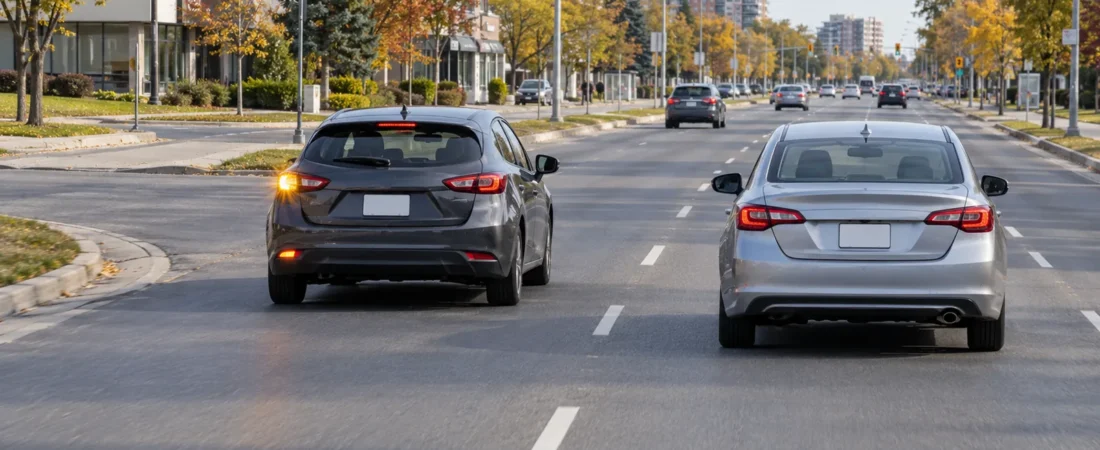
Passing on the right is not automatically illegal in Ontario, but it is often misunderstood. On a multi-lane Scarborough road, one lane may slow for a left turn while the lane beside it continues. That can be a normal traffic movement. Cutting onto a shoulder or making a sudden lane change to get around someone is a different situation—and it can quickly become unsafe.
When Ontario allows passing on the right
The Official MTO Driver’s Handbook says most passing is done on the left. It also says you may pass on the right on multi-lane roads, on one-way roads, and when overtaking a streetcar or a vehicle that is turning left.
That does not mean every right-side pass is a good decision. The handbook is equally clear that you should never pass unless you are sure you can do it without danger. A legal opportunity still requires a safe lane, enough space, good visibility and a predictable lane change.
Here is a common Scarborough example: you are travelling in the right through lane of a broad arterial, and a car in the lane to your left slows to enter a driveway or side street. If your lane continues, the markings permit through traffic and the space ahead is clear, you may keep moving at a safe speed. You do not need to brake simply to remain behind a vehicle in another lane.
Passing in a lane is not the same as using the shoulder
This distinction matters. A marked right traffic lane is designed for vehicles. The shoulder is not an extra passing lane.
According to the MTO handbook, you may drive on the right shoulder only to pass a vehicle turning left, and only when the shoulder is paved. You may not use the left shoulder to pass, whether it is paved or not.
Even where that narrow right-shoulder exception applies, first check the whole space. A paved edge may contain pedestrians, cyclists, stopped vehicles, debris, drainage grates or a shoulder that ends suddenly. If there is any doubt, wait behind the turning vehicle. Saving a few seconds is not worth entering a space you cannot read.
Do not confuse a bike lane, parking lane or bus stop area with a general traffic lane. Follow the signs and pavement markings that apply to that space. SparkOn’s guide to Ontario pavement markings can help you identify the lane before you decide to use it.
Why a sudden right-side pass causes trouble
The MTO warns that passing on the right can be more dangerous than passing on the left. If a slower vehicle is ahead of you in the far-left lane, the handbook advises waiting for that vehicle to move right instead of suddenly changing lanes to pass. The driver ahead may choose the same moment to move right.
This is the trap I want learners to recognize. You see a gap, assume the other driver will stay where they are and move quickly toward it. Meanwhile, that driver checks a mirror, sees pressure from behind and begins moving into the same lane. Your signal does not reserve the space. You still have to yield until the lane change is safe.
A rushed move also narrows your view. The slower vehicle may be hiding a cyclist, a pedestrian near the curb, traffic entering from a driveway or another car braking ahead. On roads lined with plazas and side entrances, the right lane can change character quickly.
A calm right-lane passing routine
If you are changing lanes to move past slower traffic, use a complete lane-change routine rather than treating the empty space as permission:
- Look well ahead. Confirm that the right lane continues and is not becoming a turn-only, bus or parking lane.
- Check the inside and right-side mirrors. Note the speed and position of traffic behind you.
- Signal early. Give other road users time to understand your plan.
- Check the right blind spot. Look for a car, motorcycle or cyclist beside the rear quarter of your vehicle.
- Move over gradually. Maintain a steady, legal speed; do not dive into the gap.
- Build space before returning. If you later move left, make sure you are well clear, signal and repeat the observation checks.
Review SparkOn’s full mirror-signal-shoulder-check lane-change routine if any part of that sequence feels rushed. Good passing is mostly good observation and timing.
Situations where waiting is the better choice
Near an intersection: the MTO advises against changing lanes in or near an intersection. Drivers may turn, pedestrians may enter the roadway and lane markings may change.
Beside parked vehicles: watch for opening doors and people stepping out. Leave a useful buffer instead of squeezing through a narrow gap. The Scarborough door-zone guide explains what to scan for.
Beside a cyclist: do not try to pass a bicycle within the same lane simply because the rider is keeping right. Change lanes when required and follow Ontario’s passing-distance rules, covered in our guide to driving near cyclists in Scarborough.
When the lane may end: look beyond the car you want to pass. If the right lane narrows or ends, you may have to force your way back into traffic.
When another driver is already moving: a signal, tire movement toward the line or changing gap is a reason to pause. Do not race for the same lane.
In poor weather: spray, snow, darkness and glare make the curb side harder to read. Reduce speed and choose more space.
Common learner mistakes
- Assuming a turn signal gives immediate right-of-way for a lane change.
- Accelerating above the speed limit just to finish the pass.
- Moving right without checking for cyclists or motorcycles.
- Using a paved shoulder as though it were a regular lane.
- Returning left too soon and cutting off the vehicle just passed.
- Focusing on one car instead of reading the lane, intersection and driveway activity ahead.
Another mistake is treating passing as something you must complete once started. If the gap closes or the situation changes, settle back into a safe position. A missed opportunity is not a driving error; forcing a manoeuvre can be.
The simple question to ask before moving right
Ask yourself: Is this a real traffic lane, and can I enter it without making anyone brake, swerve or guess? If the answer is not clearly yes, wait. That pause gives you time to check the markings, blind spot and traffic ahead.
If passing decisions or multi-lane traffic still feel rushed, book a driving lesson in Scarborough with SparkOn Driving Academy. We can practise lane choice, observation and timing on familiar local roads without turning the lesson into a race around slower traffic.